Follow Me

Showing posts with label World News. Show all posts

Thursday, December 26, 2013

Tuareg ends ceasefire in Mali

Separatist Tuareg ethnic group in Mali, said that it is ending the ceasefire with the government, reached in June.

This came a day after clashes troops and protesters Mali Tuareg, who prevented a visit to Prime Tatam Oumar Ly, in Kidal town.
"What has happened is a declaration of war," said the leader of the National Movement for the Liberation of Azawad.
June ceasefire came after 18 months of fighting, which forced the intervention of the French army.

Earlier, they had threatened with termination of the ceasefire, accusing the government of failing to fulfill promises.

Thailand protests: One killed by gunfire at clashes

At least one person has been killed and three wounded by gunfire after clashes broke out in the Thai capital Bangkok between rival protesters.
People heading to a pro-government rally were attacked by students, and later shots were fired.
Saturday is the seventh day of protests aiming to unseat the government of Prime Minister Yingluck Shinawatra.
Protesters claim her government is controlled by her brother, exiled former leader Thaksin Shinawatra.
He was ousted in a coup following protests in 2006 and now lives in self-imposed exile overseas.
He is one of the most polarising figures in Thai politics - he remains popular with many rural voters, while his opponents tend to be urban and middle class voters.
On Saturday, what had been largely peaceful demonstrations turned violent outside a stadium where a pro-government rally has been confined during this week to avoid clashes with the anti-government protests moving around the city, the BBC's Jonathan Head reports from Bangkok.
A group of students attacked vehicles bringing government supporters to the stadium - windows were smashed, and some minor injuries reported.
Later, shots were fired, but it is not clear yet by whom.
Police reinforcements were sent to the area and roads blocked, but skirmishes between the two sides continued for several hours.
Police have called for military backup to reinforce security in the city.
National police spokesman Piya Utayo said on Thai television that some 2,730 military personnel from the army, navy and air force will be deployed, AFP reports.
The government has been reluctant to risk deploying the military, which ousted Ms. Yingluck's brother in a coup seven years ago, but may no longer have a choice, our correspondent reports.
Tension is now rising in Bangkok as the anti-government movement prepares for what it calls a "people's revolt" - a mass occupation of government buildings all over Bangkok.
There is a high risk of greater violence if more supporters of Ms Yingluck - whose party enjoys strong backing outside Bangkok - try to come to the capital, our correspondent adds.

Ukraine opposition urges fresh polls amid pro-EU rallies

Opposition parties in Ukraine have called for early elections amid ongoing protests at the government's refusal to sign an EU association agreement.
A "national resistance" HQ is to be set up, they said, followed by a nationwide strike. Thousands have regrouped in Kiev after being forcefully dispersed.
A big rally is expected on Sunday. Jailed ex-PM Yulia Tymoshenko has urged people to overthrow the government.
Ukraine refused to sign the EU deal after apparent pressure from Russia.
At the end of a summit in the Lithuanian capital on Friday, EU leaders warned they would not tolerate Russian interference in the bloc's relations with former Soviet republics.
The summit reached provisional accords with Georgia and Moldova.
Several Western countries have condemned Saturday morning's intervention at about 04:30 (02:30 GMT) to disperse protesters gathered in Independence Square.
A number of people were hurt.
Police said they had decided to clear Independence Square after "a number of incidents", Interfax Ukraine news agency reported.
It was not clear what incidents they were referring to.
"It was horrible. We were holding a peaceful demonstration and they attacked us," said protester Lada Tromada.
"They threw us away like garbage."
One activist, opposition MP Andriy Shevchenko, said at least 33 taken into police custody.
Members of the political opposition met for emergency talks after the dispersal.
"We have made a joint decision to form a national resistance taskforce and have begun preparing for an all-Ukrainian national strike," former Economy Minister Arseniy Yatsenyuk told reporters.
"Our demands are the resignation [of Interior Minister Vitali] Zakharchenko, an investigation of his actions and his trial, the resignation of the government and the president and early presidential and parliamentary polls.
"We... are calling on all civic activists, civil society and all those who care about Ukraine's future to fight the Viktor Yanukovych regime together."
A big rally has been announced for Sunday.
Former Prime Minister Yulia Tymoshenko has urged protesters not to give in "until the regime is overthrown by peaceful means".
In a message read by her daughter, Ms Tymoshenko urged Ukrainians: "Fly, drive, walk to Kiev from all parts of Ukraine, but gather everyone on 1 December."
'Foreign pressure'
Last week, Ukrainian President Viktor Yanukovych said he was suspending preparations for signing an EU association agreement that would have opened borders to goods and set the stage for an easing of travel restrictions.
He said pressure from Russia had led him to make his decision. Mr Yanukovych argued that Ukraine could not afford to sacrifice trade with Russia, which opposed the deal.
EU Council President Herman Van Rompuy said the parties had been "really close" to signing the association agreement in Vilnius, but added: "We need to overcome pressure from abroad."
German Chancellor Angela Merkel said the door would always remain open for Ukraine.
Independence Square was the scene of the Orange Revolution in 2004, which saw Mr Yanukovych ousted and a Western-leaning government brought to power.
Mr Yanukovych was elected president five years later, narrowly defeating then-Prime Minister Tymoshenko, a leading figure of the Orange Revolution.
In 2011 she was sentenced to seven years in jail for abuse of office - a case widely criticised in the West as political revenge.
Ms Tymoshenko has been on hunger strike since Monday over the failure to sign the EU agreement.

Leading Egyptian activist turns himself in

The protest law, passed a week ago by the army-backed interim government, has provoked an outcry among rights groups. The army deposed elected Islamist president Mohamed Mursi on July 3, following mass protests against his rule, and the country has seen widespread unrest since.
Maher and around 100 supporters made their way to the Abdeen court, chanting: "Down, down with military rule! I'll write on the prison wall that army rule is shameful and a betrayal!"
Clashes broke out between security forces and activists outside the court after Maher turned himself in. Police fired tear gas and used their batons to disperse the crowd.
Maher will be detained for at least a day one day while his case is investigated, prosecution sources told Reuters.
On Thursday, police arrested activist Alaa Abdel Fattah, also known for his role in the anti-Mubarak uprising. Arrest warrants had been issued for both men after they joined demonstrations outside parliament to defy the protest law.

Liberals and activists who backed Mursi's overthrow are becoming more vocal against the military, which has pursued a crackdown against Islamists in which hundreds have been killed and more than 2,000 arrested.The new law gives the Interior Ministry the right to ban any meeting of more than 10 people in a public place.
Security forces accuse Mursi's Muslim Brotherhood and their supporters of promoting terrorism and violence. Many of the group's leaders including Mursi have been put on trial.
The group says it rejects violence and accuses the army of staging a military coup against a democratically elected government.

R.I.P. Actor Paul Walker, Dead at 40

Walker was reportedly taking friends for test rides in his new Porsche GT in Santa Clarita, when the driver lost control and slammed into a tree that sent the car bursting into flames, killing Walker and one other passenger. It's still unclear who was driving at the time.

The 40-year-old actor had been appearing in various movies and TV shows since the mid-80s but his real breakthroughs came in the early 00's when he was teamed with director Rob Cohen, first for The Skulls and then the first The Fast and the Furious. Walker returned for the sequel 2 Fast 2 Furious, but then bowed out of the series, returning six years later for Fast & Furious 4. That movie relaunched the series to the blockbuster status that it's enjoyed for the last three movies, while Walker has appeared in smaller, independent projects in between.

Walker was in the middle of shooting Fast and Furious 7 with Vin Diesel and new director James Wan and it's undetermined how much more Walker had to shoot on the film or whether rewrites and changes will have to be done.

Walker will next appear in the indie thriller Hours, a passion project of his written and directed by Eric Heisserer, that premiered at the SXSW Film Festival and was due for a limited release on December 13.

This may be one of the most shocking deaths in recent memory, reminding us of the death of Heath Ledger months before he would achieve his greatest success playing the Joker in Christopher Nolan'sThe Dark Knight. It's a huge loss to the industry, especially the popular "Fast and Furious" franchise, which he helped to nourish.

Ukraine unrest: PM warns against 'escalating tensions'

Ukraine's Prime Minister Mykola Azarov has called on the opposition to stop escalating "political tensions".
He warned protesters that anybody found guilty of violating the constitution and laws would be punished.
Mr Azarov was speaking in a live broadcast from the first cabinet meeting since mass street protests began just over a week ago.
The de
monstrations were sparked by the government's decision not to sign an association deal with the EU.
The protests are the largest since the pro-democracy Orange Revolution in 2004.
'Dangerous situation'
With the help of police, government ministers managed to bypass a blockade of protesters outside government buildings to hold their regular cabinet meeting.
In his address, Mr Azarov called on opposition parties to end the "escalation of political tensions" following his government's survival of a no-confidence vote in parliament on Tuesday.
He told protesters: "Your leaders are putting you up to a crime. They will try to hide behind lawmaker immunity. But you will have no-one to hide behind."
He said "the reasons for the street protests have been exhausted".
Foreign Minister Leonid Kozhara accused "mostly" right-wing European politicians of "inspiring their political partners" in the Ukrainian opposition to continue the protests.
He called on those European politicians to urge the Ukrainian opposition "to sit together with the government to look for ways out of this extremely dangerous situation".
Mr Azarov said earlier this week he would send a delegation to Brussels on Wednesday to renew talks on the deal Ukraine had been expected to sign with the EU.
The office of the EU's foreign policy chief, Catherine Ashton, could not on Tuesday confirm the visit. In a statement, it said it was "ready" to discuss various aspects of the agreement with Ukrainian officials but would not "reopen negotiations on the text".
Ukraine is also reportedly sending a delegation to Moscow, whose customs union it has agreed to join instead.
Meanwhile, Ukrainian and Russian energy firms have reportedly agreed to defer until next spring Kiev's payments for Russian gas imported from October to December.
Russia has in the past cut Ukrainian gas supplies in mid-winter.
Leaving behind his troubles at home, Ukraine's President Viktor Yanukovych has begun a three-day official visit to China in what is reported to be a bid to forge closer economic ties.
Both he and Mr Azarov are facing calls for their resignation from the protesters.
Mr Yanukovych has called for peaceful protests and both sides to observe the law after violence broke out over the weekend. "Any bad peace is better than a good war," he said.
Before Tuesday's emergency session of parliament Mr Azarov apologised for the use of police force against protesters at the weekend.

Ukraine protesters topple Lenin statue in Kiev

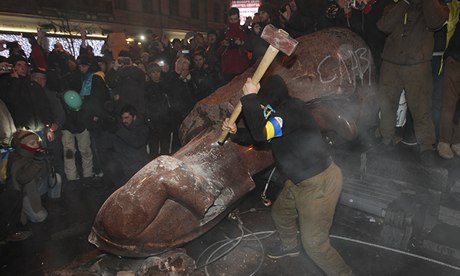
Ukrainian opposition protesters toppled a statue of Lenin in central Kiev as hundreds of thousands took to the streets in the latest display of anger at the government's rejection of closer ties with Europe.
A group of protesters dragged down the statue on Sunday evening, taking turns to beat the fallen landmark.
Smashes Lenin statue KievEarlier, the opposition threatened to march on Viktor Yanukovych's presidential palace and seal him inside if he did not give ground in the deepening standoff between the people and the president over the country's future.
Hundreds of thousands of people crammed into Independence Square and the surrounding streets on Sunday, chanting "Ukraine is Europe!" and calling on Yanukovych to resign, in the biggest protest yet of a two-week movement to force the president to reverse a decision to halt European integration.
Addressing the crowds, opposition leaders said they gave Yanukovych 48 hours to sack his prime minister, or they would march on his palatial residence outside Kiev and shut him in.
The protesters carried the yellow-and-blue flags of both Ukraine and the European Union. Although some also waved flags of political parties, the majority of those on the streets were not supporters of particular parties.
One man wielded an effigy of the severed head of the late Libyan leader Muammar Gaddafi above a sign reading: "Vitya [Yanukovych], the game is over!"
"We do not want to be kept quiet by a policeman's truncheon," heavyweight boxer and opposition leader Vitali Klitschko told the crowd.
Since last Sunday, when protesters attempted to storm the presidential administration and riot police responded ruthlessly, there has been no violence. The government has so far taken a hands-off approach to the protests but resisted concessions. The prime minister, Mykola Azarov,survived a no-confidence vote in parliament on Tuesday and has branded those on the square "Nazis and criminals", but after previous attempts to clear the square with force increased the protest mood, police withdrew from the city centre.
However, on Friday, Kiev police said that if two occupied buildings in the centre, including the main City Hall, were not vacated within five days, they would be cleared with force.
On Sunday, Eduard Leonov, an MP from the nationalist Svoboda party, was sitting at a desk marked "Committee for the self-government of Kiev" inside City Hall, and described himself as the commander of the building. He insisted that protesters would not acquiesce to the police demands.
"First, it's an illegal order, as MPs have the right to hold meetings wherever they want," he said. "Second, it's an immoral order, as this is a humanitarian mission providing food and warmth to the protesters."
Hundreds of mattresses have been laid out on the floor in the City Hall's main colonnaded room, and different stalls hand out food, medicines and donated warm clothes to those who want them.
"It the government decides to storm the building, then of course we will resist," said Leonov.
Yanukovych has kept a low profile since the protests started, even flying to China for a three-day trip last week as the centre of Kiev remained under siege. He returned to Ukraine on Friday, stopping over in Russia to meet with Vladimir Putin, with rumours circling in Kiev that the pair had agreed for Ukraine to join the Russian-led Customs Union. The rumour sparked fury in Kiev but was denied by spokespeople for both presidents.
Russia and the west have traded allegations over which side is putting pressure on Ukraine. On Saturday, former Georgian president Mikheil Saakashvili told the crowd on Independence Square that Putin had performed a "raider attack on a whole sovereign country", attempting to steal Ukraine's fate from its own people.
Alexei Pushkov, the head of the Russian parliament's foreign affairs committee, struck back: "Saakashvili is kind of right. There is an attempted raid on Ukraine, not from Moscow but Brussels, grabbing it by the neck and dragging it to paradise," he wrote on Twitter. "The word 'paradise' should be in inverted commas, of course. For Bulgaria, Greece and even for Serbia which is just an EU candidate country, the promised 'paradise' turned to hopeless gloom."
Yanukovych has insisted he still wants integration with Europe, but could not sign the EU deal as it would have caused further damage to Ukraine's suffering economy.

Catherine Deneuve accepts lifetime achievement award with cool aplomb

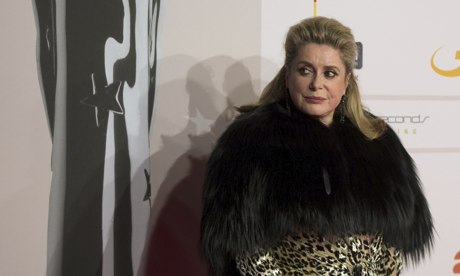
The wet snow that fell on Berlin on Saturday evening had nothing on thefroideur of Catherine Deneuve, in town to receive a lifetime achievement prize at the European film awards and not best pleased about it either. "Lifetime achievement – those are not good words," the 70-year-old French actor told the press before the ceremony. "To achieve life is to mean that you are dead. It's not an award you give to someone who is still alive."
Catherine DeneuveDeneuve was honoured for an impressive 50-year back catalogue that stretches from roles in The Umbrellas of Cherbourg, Repulsion and Belle de Jour through to more recent work in the likes of Lars von Trier's Dancer in the Dark and François Ozon's Potiche. Along the way she has been the muse of the designer Yves Saint Laurent and served as the model for Marianne, the national symbol of France.
On stage at the 26th European film awards, the guests lined up to eulogise her. "You are without doubt one of the greatest actresses in the world," said Wim Wenders, president of the European film academy. "You are the queen of European cinema, if we had royalty, and at the same time the most beautiful woman on earth."
Deneuve suffered the tributes with an air of pained good grace. Following an extended montage of her greatest roles, she confessed that she rarely looked back on her early work because she is too busy working or watching new films. She is a big fan of the US actor Jennifer Lawrence and cited the acclaimed coming-of-age love story Blue is the Warmest Colour as one of her favourite recent films. "It's a very effective and powerful film," she said. "And the two main actors are just incredible."
Despite winning the Palme d'Or award at Cannes, the film came up short at the ceremony in Berlin. Instead the night was dominated by The Great Beauty, Paolo Sorrentino's opulent satire on Rome's cultural elite. His drama won four awards, including best film, best director and best actor for its star, Toni Servillo. The best actress prize went to Veerle Baetens for the Belgian film The Broken Circle Breakdown, while Joshua Oppenheimer's The Act of Killing was named best documentary. Ari Folman's European co-production The Congress took the animation award. Susanne Bier's Love is All You Need scooped the inaugural comedy prize. Sarah Greenwood, production designer on Anna Karenina, was the evening's lone British winner.
Picking up an honorary award for "European achievement in world cinema", Pedro Almodóvar paid tribute to embattled film-makers in his native Spain, where government cuts has led to a 28% drop in domestic movie production. "This has been one of the worst years for our industry," said the director. "And it is caused by the awful cultural policy of our government."
The financial crisis was the great uninvited guest at this year's European film awards, which were described by Marion Doring, director of the academy, as being "poor but sexy". The presenters fluffed their lines and tripped over their dresses, while the event unfolded in a spirit of mordant humour and merry disarray.
Conceived as a riposte to the Hollywood-dominated Oscars, the 26th EFAs contrived to make a bonus of its ramshackle, unorthodox nature. "Turn on your cellphones really loud," the event's host, Anke Engelke, told guests inside the auditorium. "Smoke and drink in your seats."
Deneuve, a defiant smoker who nursed a cigarette throughout the press conference, may have been mollified by that sentiment.

US attempts to halt Paris auction of sacred Native American artefacts

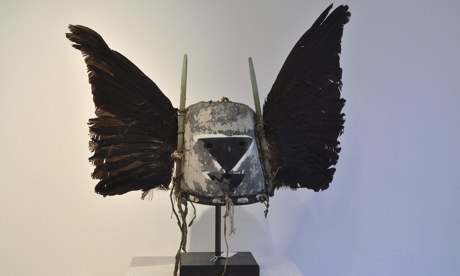
International campaigners are making last-minute efforts to halt the sale in Paris of sacred ceremonial masks and headdresses from Native American tribes.
Native American artefacts due to be auctioned in ParisThe US embassy appealed to the auction house to delay the sale, due to be held on Monday and Tuesday, so the 25 items from the Hopi and San Carlos Apache tribes can be identified to see whether they can reclaim them.
The battle follows attempts to halt an auction of 70 Hopi masks in Paris in April. Even the intervention of the Hollywood actor Robert Redford, who described the earlier sale as a "criminal act … that could have serious moral consequences", was not enough to halt the €930,000 (£780,000) sale.
On Friday, Survival International, which campaigns for the rights ofindigenous peoples, lost a legal challenge over the latest auction. The French judge, Claire David, said neither moral nor philosophical considerations could justify preventing a legal sale.
On Saturday, Mark Taplin, the US charge d'affaires in Paris, delivered a letter to the EVE auction house asking for the sale to be delayed.
"The embassy made this request on behalf of the two tribes so that they might have the opportunity to identify the objects, investigate their provenance and determine whether they have a claim to recover the items under the 1970 Unesco convention on the export and transfer of ownership of cultural property, to which France is a signatory, or under other laws," the embassy said in a statement.
US diplomats emphasised the "great importance" of the objects to the Native Americans and said they should not be sold "precipitously and in the absence of consultation" with the two tribes.
The sale of sacred Native American artefacts was banned in the US in 1990 but there is no similar legislation in France.
The EVE auction will sell more than 100 Amerindian artefacts, but the rare masks, described as "exceptional" are the most contested. Among them, is a version of the Tumas Crow Mother mask dating from the 1860s and given a catalogue price of between €60,000 and €80,000.
EVE auctioneer Alain Leroy said: "Never has a sale of Amerindian art gathered together as many ancient and rare objects."

German president boycotts Sochi Winter Olympics

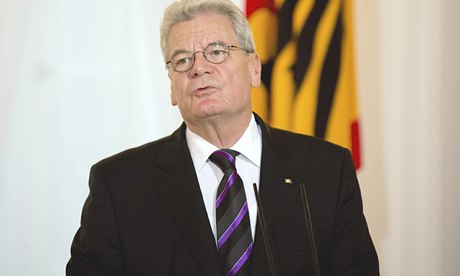
The German president has become the first major political figure to boycott the Sochi Winter Olympics in February. According to German weekly Der Spiegel, Joachim Gauck last week told the Kremlin of his decision, which is understood to be a response to the Russian government's violations of human rights and harassment of the opposition.
Gauck, a former Lutheran pastor who played a key part in the East German protest movement before the fall of the Berlin Wall, has declined any official visits to Russia since coming to office in March 2012 and repeatedly criticised the country's "deficit of rule of law" and "air of imperialism".Joachim Gauck, the German president
In June, a scheduled meeting between Gauck and his Russian counterpart, Vladimir Putin, was cancelled – supposedly because of clashing schedules. Gauck visited the Olympics and the Paralympics in London last summer.
The head of the Russian parliament's foreign delegation on Sunday criticised Gauck's decision. Alexey Pushkov tweeted: "The German president Gauck has not criticised the killing of children and women in Pakistan and Afghanistan. But he is so critical of Russia that he doesn't even want to travel to Sochi."
The boycott is the first of the Games by a major political figure. So far, it has mainly been artists and activists such as Stephen Fry, Harvey Fierstein and Lady Gaga who have called for a boycott of the Sochi Games in reaction to a new Russian law that criminalises gay "propaganda".
In an open letter in June to the British prime minister and the IOC, Fry said "an absolute ban on the Russian Winter Olympics of 2014 in Sochi is simply essential". David Cameron has ruled out a boycott, arguing that anti-gay prejudice would be better tackled by presence rather than absence.
The German chancellor, Angela Merkel, has since echoed Cameron's stance, pointing to the Eurovision song contest in Azerbaijan as proof that public attention could do more to change attitudes than boycotts.
In July, US senator Lindsey Graham also called for a US boycott of the Gamesin July, though his motives had been slightly different: the South Carolina Republican said Russia needed to be rebuked for offering asylum to Edward Snowden.
While Germany under chancellors Gerhard Schröder and Merkel has traditionally been keen to tread carefully in diplomatic exchanges with Russia, a standoff between Gauck and Putin has seemed only a matter of time.
Gauck, in his post-1989 role as special representative for Stasi archives, has come to represent a systematic investigation into the crimes of East Germany's surveillance state, while former KGB agent Putin has overseen the rehabilitation of secret service personnel during his time in power. In German political circles, it is no secret that there is little love lost between the two presidents.
On Sunday, Gauck's office confirmed he had declined to travel to Russia next February, but seemed to pull back from explicitly describing his decision as a boycott.
A spokeswoman said there was no fixed rule that the president had to visit the Olympics, and that president Horst Köhler did not visit the 2010 Games in Vancouver.
The German Union of Olympic Athletes said no visit by the president to Sochi had ever been planned in the first place. Gauck was, however, planning to take part in a welcoming party in Munich for returning German Olympians.

Greek parliament approves budget projecting sliver of growth

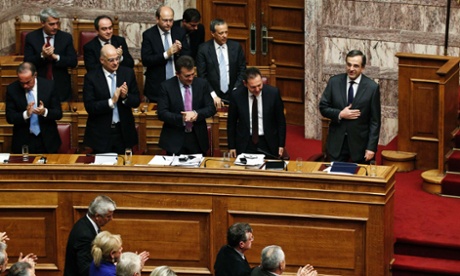
Greece's parliament approved a budget plan on Saturday that included more than €3bn (£2.51bn) of austerity cuts, with the debt-laden country hoping to emerge from a six-year recession next year.
After nearly going bankrupt and almost crashing out of the euro zone last year, Greece expects growth of 0.6% in 2014 and hopes to secure more leeway on its debts to the European Union and the International Monetary Fund.
"This is a historic day," prime minister Antonis Samaras told MPs, calling the 2014 plan a budget of recovery and hope. "People's sacrifices bore fruit and changed the course of the country."
Outside parliament, an anti-austerity rally called by the country's largest labour unions drew only a few hundred people, a shadow of former demonstrations in which tens of thousands took to the streets of Athens to protest against cuts.
MPs applaud Antonis Samaras during the budget debate.
Samaras's conservative-led coalition controls 154 seats in the 300-seat parliament, and 153 MPs voted in favour of the budget plan. 
A 2013 budget surplus of €812m before interest payments is forecast thanks to higher than expected tax revenues. Posting a primary surplus is key as it would open the way for Greece to pursue debt relief from the EU and IMF.
But Athens and its lenders disagree on the forecasts for 2014, arguing over the size of a potential budget gap next year and the slow pace of reforms.
International lenders have not given their approval for the plan, which sticks to a target for a primary budget surplus (before interest costs) of about 1.5% of GDP next year, and have said that unless it found new savings, Athens would miss its surplus target by about €2bn.
Greece's finance minister, Yannis Stournaras, says the difference has narrowed to about €1bn.
The so-called troika of EU, IMF and European Central Bank inspectors, who left Athens last month, will return in January to complete their latest review, the IMF said. The troika's technical teams were expected to continue talks in Athens next week.
The review, which has dragged on since September, is crucial to the release of up to €5.9bn in bailout funds, although Greece has no immediate funding pressures.
The lenders want Greece to ease restrictions on bank foreclosures and on companies carrying out mass layoffs. Samaras has rejected further across-the-board wage and pension cuts to fill any budget gaps.
The economy has shrunk by nearly a quarter since 2008, and repeated rounds of austerity have squeezed households and sent unemployment to record highs of more than 27%.
"The bailout has destroyed Greece and will be remembered in history as a tragedy," Alexis Tsipras, head of the main opposition, the leftist Syriza party, said during the debate.

MPs' pay authority faces mass defiance over proposal to raise salaries by 11%

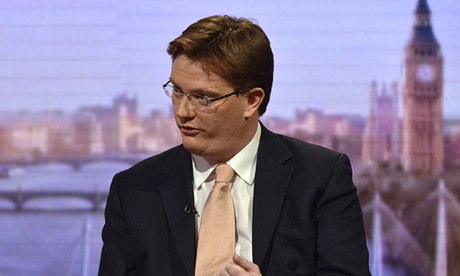
The Independent Parliamentary Standards Authority (Ipsa) faces mass defiance from parliamentarians when it presses ahead with plans to increase their pay to £74,000, it has emerged.
Danny Alexander, the chief secretary to the Treasury, said the proposed increase was "utterly incomprehensible", while Philip Hammond, the defence secretary, said he would expect the cabinet to take a collective stand against the Ipsa ruling. Ed Balls, the shadow chancellor, said he could not see himself telling Labour MPs to accept the money.The Andrew Marr Show
They were speaking after it was revealed that Ipsa will reject calls for restraint when it publishes on Thursday its final plans to reform MPs' pay and pensions.
It will recommend that MPs should be paid £74,000 a year after the general election – representing an 11% increase on the £66,396 a year they get now, or a 9% increase on what their pay would otherwise be in 2015-16 allowing for normal pay rises.
Ipsa had proposed the rise in a consultation in June, when it also received near-universal condemnation from parliamentarians who argued that it was unacceptable to push through such an increase at a time when many other workers in the public sector were seeing their pay frozen in real terms.
In June, Ipsa also proposed that the pay increase should be matched by cuts to the value of MPs' pensions. According to one source familiar with the authority's thinking, these proposals have been hardened up since the summer, meaning that MPs' pensions will become even less generous.
As a result, Ipsa will be able to argue that its proposals would result in no net increase to the cost of MPs' pay and pensions. The June package would have increased their cost by £500,000 a year.
But Alexander told the BBC's Andrew Marr Show that increasing MPs' salaries in line with what was being proposed was unacceptable.
"Most people will find it utterly incomprehensible that at a time of pay restraint for the public sector, at a time of further squeezes on government spending, that Ipsa should be recommending [this increase]," said Alexander, who declared that he would refuse to accept the money.
"I think it would be wholly inappropriate for MPs to get such a large pay rise at a time when every other public sector worker sees their pay rises capped at 1%."
Hammond told Radio 5 Live: "So long as I'm the defence secretary presiding over a situation where the troops that serve our country so brilliantly are facing a 1% pay rise, I won't be taking a pay increase."
He said he expected all cabinet ministers to take the same approach.
"I suspect that the prime minister would want cabinet ministers to make a clear, collective statement about what they would do. I suspect there will be a strong mood in the cabinet that we all need to say the same thing."
Balls said he would expect Labour MPs to take the same approach. Ipsa had produced a report "entirely out of any context of the real world", he said.
"How could I possibly say to Labour MPs at this time, with the economy like this, with the economy under real pressure, there's a cost of living crisis, that they should take a pay rise?"
Ipsa was created after the MPs' expenses scandal because it was thought that it was best for MPs to lose the right to set the level of their own pay and expenses. MPs have no power to block the increase unless they pass legislation tearing up the whole Ipsa framework.
There would be nothing to stop MPs who receive the rise after 2015 handing it back to the Commons authorities, or instead donating it to charity, and it now appears that many MPs will go into the general election promising exactly that. Potentially this could also lead to fresh calls for legislation, making MPs' pay an election issue.
In June, all three main party leaders criticised the proposed increase. Ed Milband and Nick Clegg both said that they personally would refuse to accept an increase, although David Cameron was more guarded.
Downing Street said on Sunday that the government believed the cost of politics should be going down.
"The government has submitted its views to Ipsa as part of the body's consultation on MPs' pay. It made it clear that, while Ipsa is an independent body set up by parliament, in future decisions on remuneration it expects Ipsa to take into account the government's wider approach to public service pay and pensions," a spokeswoman said.
"We believe that the cost of politics should be going down, not up."
On Sunday, several MPs used Twitter to say that they, like Alexander, would refuse to accept the proposed rise. They included Andy Burnham, the shadow health secretary, Steve Webb, the Lib Dem pensions minister, Labour MPs John Mann and John Woodcock and the Conservative Andrew Stephenson.
But Sir Peter Bottomley, the Conservative MP, said his colleagues should accept Ipsa's ruling. "Each leader will say this is the wrong amount at the wrong time. The fact is, it was the leaders who set up the Ipsa system who are given the responsibility to set the level of pay and people can't interfere with it," he said.
"The only way MPs could overturn this is to defy their leaders and pass a law saying Ipsa is abolished or it will be ignored. That's impractical given the public interest in setting up Ipsa in the first place."
A source familiar with Ipsa's thinking said that if MPs were unhappy with the increase they only had themselves to blame. For years, when they were in charge of their own pay, they avoided large salary increases, because those were unpopular with the electorate, while allowing themselves to recoup the money they were losing through expenses that became ever more generous and hard to justify.
"MPs, and governments, had decade after decade after decade to deal with this, and they never did. They made a mess of it," said the source. "History tells us that they would do it again if they had the chance."

Ukraine protesters topple Lenin statue in Kiev

Ukrainian opposition protesters pulled down a statue of Lenin in central Kiev as hundreds of thousands took to the streets in the latest display of anger at President Viktor Yanukovich's rejection of closer ties with Europe.
Protesters used ropes to topple the monument, and several then scrambled onto the podium to plant Ukrainian and European flags. Hundreds gathered around to sing the national anthem and chanting "Yanukovich, you're next".
A huge crowd formed, desperate to catch a glimpse of the fallen Bolshevik leader, while passing cars beeped their horns in support. Some took hammers to the fallen statue in an attempt to smash it to pieces and claim souvenirs.
Not everyone approved of the sudden moment of drama, perhaps the most symbolic yet in two weeks of anti-government protest. "They should have got rid of Lenin ages ago, but I'm not sure this is the right way to do it," said Oksana Petrenko. "I've been at the protest for days but we have to avoid it turning violent."Smashes Lenin statue Kiev
Earlier, the opposition threatened to march on Yanukovych's presidential palace and seal him inside if, in the next 48 hours, he did not sack his prime minister.
Hundreds of thousands crammed into Independence Square and nearby streets on Sunday, chanting "Ukraine is Europe!". They called on Yanukovych to resign in the biggest protest yet of a two-week movement to force the president to reverse a decision to halt European integration.
The protesters carried the yellow-and-blue flags of both Ukraine and the European Union. Although some also waved flags of political parties, the majority of those on the streets were not supporters of particular parties.
One man wielded an effigy of the severed head of the late Libyan leader Muammar Gaddafi above a sign reading: "Vitya [Yanukovych], the game is over!"
"We do not want to be kept quiet by a policeman's truncheon," heavyweight boxer and opposition leader Vitali Klitschko told the crowd.
Since last Sunday, when protesters attempted to storm the presidential administration and riot police responded ruthlessly, there has been no violence. The government has so far taken a hands-off approach to the protests but resisted concessions. The prime minister, Mykola Azarov,survived a no-confidence vote in parliament on Tuesday and branded those on the square "Nazis and criminals", but after previous attempts to clear the square with force increased the protest mood, police withdrew from the city centre.
However, on Friday, Kiev police said that if two occupied buildings in the centre, including the main City Hall, were not vacated within five days, they would be cleared with force.
On Sunday, Eduard Leonov, an MP from the nationalist Svoboda party, was sitting at a desk marked "Committee for the self-government of Kiev" inside City Hall, and described himself as the commander of the building. He insisted that protesters would not acquiesce to the police demands. "First, it's an illegal order, as MPs have the right to hold meetings wherever they want," he said. "Second, it's an immoral order, as this is a humanitarian mission providing food and warmth to the protesters."
Hundreds of mattresses have been laid out on the floor in the City Hall's main colonnaded room, and different stalls hand out food, medicines and donated warm clothes to those who want them.
"It the government decides to storm the building, then of course we will resist," said Leonov.
Yanukovych has kept a low profile since the protests started, even flying to China for a three-day trip last week as the centre of Kiev remained under siege. He returned to Ukraine on Friday, stopping over in Russia to meet with Vladimir Putin, with rumours circling in Kiev that the pair had agreed for Ukraine to join the Russian-led Customs Union. The rumour sparked fury in Kiev but was denied by spokespeople for both presidents.
Russia and the west have traded allegations over which side is putting pressure on Ukraine. On Saturday, former Georgian president Mikheil Saakashvili told the crowd on Independence Square that Putin had performed a "raider attack on a whole sovereign country", attempting to steal Ukraine's fate from its own people.
Alexei Pushkov, the head of the Russian parliament's foreign affairs committee, struck back: "Saakashvili is kind of right. There is an attempted raid on Ukraine, not from Moscow but Brussels, grabbing it by the neck and dragging it to paradise," he tweeted. "The word 'paradise' should be in inverted commas, of course. For Bulgaria, Greece and even for Serbia which is just an EU candidate country, the promised 'paradise' turned to hopeless gloom."
Yanukovych has insisted he still wants integration with Europe, but could not sign the EU deal as it would have caused further damage to Ukraine's suffering economy.

Nelson Mandela: How Africa has changed in his lifetime

Nelson Mandela was born into a continent colonised and in servitude to European powers. Only Ethiopia and Liberia were independent. But Germany's defeat in the first world war brought about a reworking of the colonial order with its possessions in what are now Tanzania, Cameroon, Togo, Burundi and Rwanda distributed among the war's victors – Britain, France and Belgium. German South West Africa, now Namibia, fell under South African control.
Artillery company of the Nigeria Regiment
Mandela was a citizen of a new country: South Africa had been born eight years earlier with the unification of four British colonies, including the two former Afrikaner republics of the Transvaal and the Orange Free State, taken over after the Boer war. Ironically, the Boer struggle was widely seen as the first anti-colonial fight of the 20th century against the British empire.
The Abyssinia South Africa, because of its large white population, was a politically autonomous dominion under the British crown, unlike the UK's other African colonies. In 1918, some territories were still regarded as the private property of commercial companies. Southern Rhodesia, now Zimbabwe, was owned by the British South Africa Company and would not be recognised as a colony until 1923.
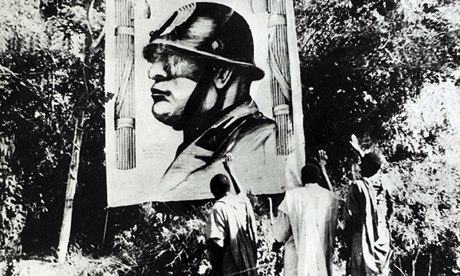
Ethiopia was one of only two independent countries in Africa when the Italian fascist dictator, Benito Mussolini, decided to expand his small "African empire". Italy invaded in 1936, overthrowing Emperor Haile Selassie and confirming the League of Nations as toothless in the face of fascist aggression. Ethiopia was integrated into Italian East Africa with Eritrea and Italian Somaliland.
From 1940, the desert war ranged across north Africa for three years, swinging from French Tunisia through Italian Libya to within striking distance of Cairo. That conflict once again remade the colonial map, with Italy forced to relinquish its rule of Libya and Somalia, and Ethiopia liberated in 1941. It was also deciding the future of imperial rule in less immediately evident ways. After the war, France recovered possession of Tunisia, where a sizeable expatriate population lived, but its authority was fatally undermined and it was independent within a few years, along with Morocco.
Newly demobilised African soldiers who served the allied cause in north and east Africa, Europe and Asia arrived home questioning the disconnect between the Allies' trumpeting of freedom with the continued subjugation of their own continent.
A smattering of well-educated anti-colonial leaders provided the arguments and the direction to draw increasingly restless Africans into the struggle for their freedom.